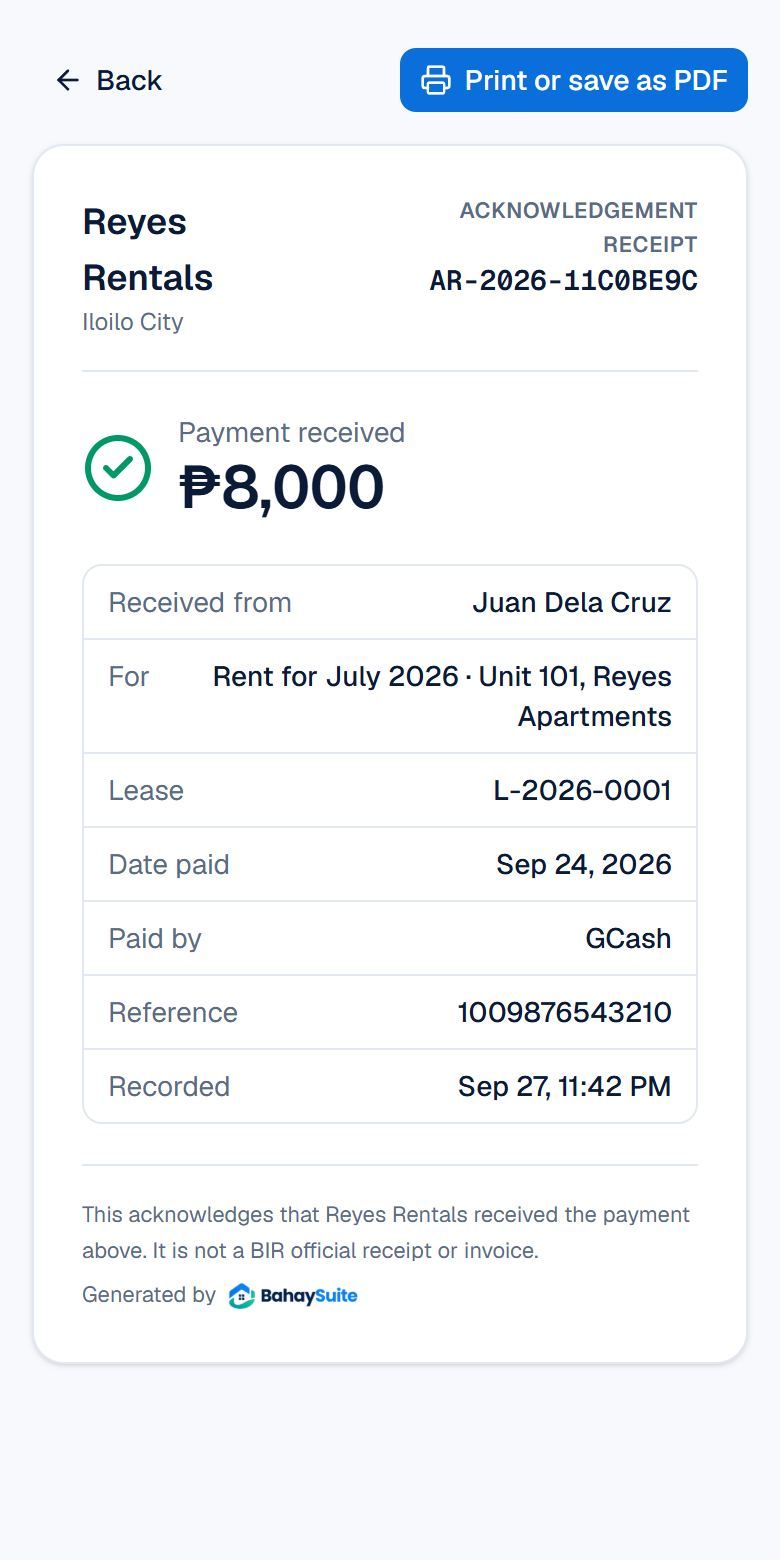



A receipt protects both of you. Your tenant can prove they paid, and you have a clean record when there’s a question about a missed month, a partial payment or the deposit at move-out. A GCash screenshot shows that money was sent, not what it was for, so write a receipt even for e-wallet payments.
What to write on a rent receipt
- Receipt number, in order (0001, 0002…), so gaps are easy to spot.
- Date paid.
- Received from: the tenant’s full name.
- Amount in figures and in words, e.g. ₱8,000.00 (eight thousand pesos).
- What it’s for: rent for which month, the unit and address. Write deposit and advance separately from rent.
- How it was paid: cash, GCash, Maya or bank transfer, with the reference number.
- Balance remaining, if it was a partial payment.
- Received by: your name and signature (on paper).
A template you can copy
- ACKNOWLEDGEMENT RECEIPT No. 0012
- Date: October 5, 2026
- Received from: Juan Dela Cruz
- Amount: ₱8,000.00 (eight thousand pesos)
- For: Rent for October 2026, Unit 3A, 123 Mabini St., Caloocan City
- Paid by: GCash, reference no. ____________
- Balance remaining: ₱0.00
- Received by: ____________ (name and signature)
Acknowledgement receipt vs BIR invoice
The receipt above is an acknowledgement receipt: proof between you and your tenant that you received the money. If you’re registered with the BIR as a lessor, you also issue a BIR-registered invoice for rent. Since 2024, under the Ease of Paying Taxes Act, invoices replaced official receipts as the main document for services, rent included. An acknowledgement receipt doesn’t replace it.
Receipts in BahaySuite
Every payment you record or confirm in BahaySuite gets a numbered acknowledgement receipt with all of the above filled in. Your tenant opens and prints it from their pay link, on every plan including Free. See Collect rent.